Circulate AB · Stockholm Perspective for Q3 2026 round Confidential
A perspective

The operating system for packaging.

The packaging industry's data layer doesn't exist yet. We're building it.

TL;DR

Circulate is building the canonical data layer for European packaging – a structured graph of SKUs, materials, suppliers and certificates that every compliance tool, marketplace and procurement system will need.

Why now EU PPWR obligations live since 12 Aug 2026 + AI document understanding
Traction 10 MSEK+ gross sales, last 12 months · 3× YoY growth
Raising 3–4 MSEK · profitability within 18–24 months
Market €1.2tn global industry rebuilding its data foundation

A €1.2 trillion global industry, rebuilding its data foundation.

A data graph is a network of connected data: an intelligent data foundation where every packaging SKU links to its materials, suppliers, certificates and impact, ready for any tool to query.

The original thesis was right about the symptom: accidental buyers without time, knowledge or leverage facing an opaque, analogue, deeply technical market. Packaging isn't core, so it goes under-resourced, yet it's business-critical, landing as a side project on whoever has bandwidth. Most default to the same suppliers for a decade, overpaying for something mediocre, with no obvious way to fix it.

The industry has been calling out for tooling: marketplaces, comparison engines, restock automation, compliance reporting. None of it works without structured data, and that data exists only in PDF spec sheets, disconnected ERPs, and the heads of a dwindling number of packaging engineers. Never as a queryable layer a tool can be built on. Every tool has had to ask users to re-enter the same data into yet another silo.
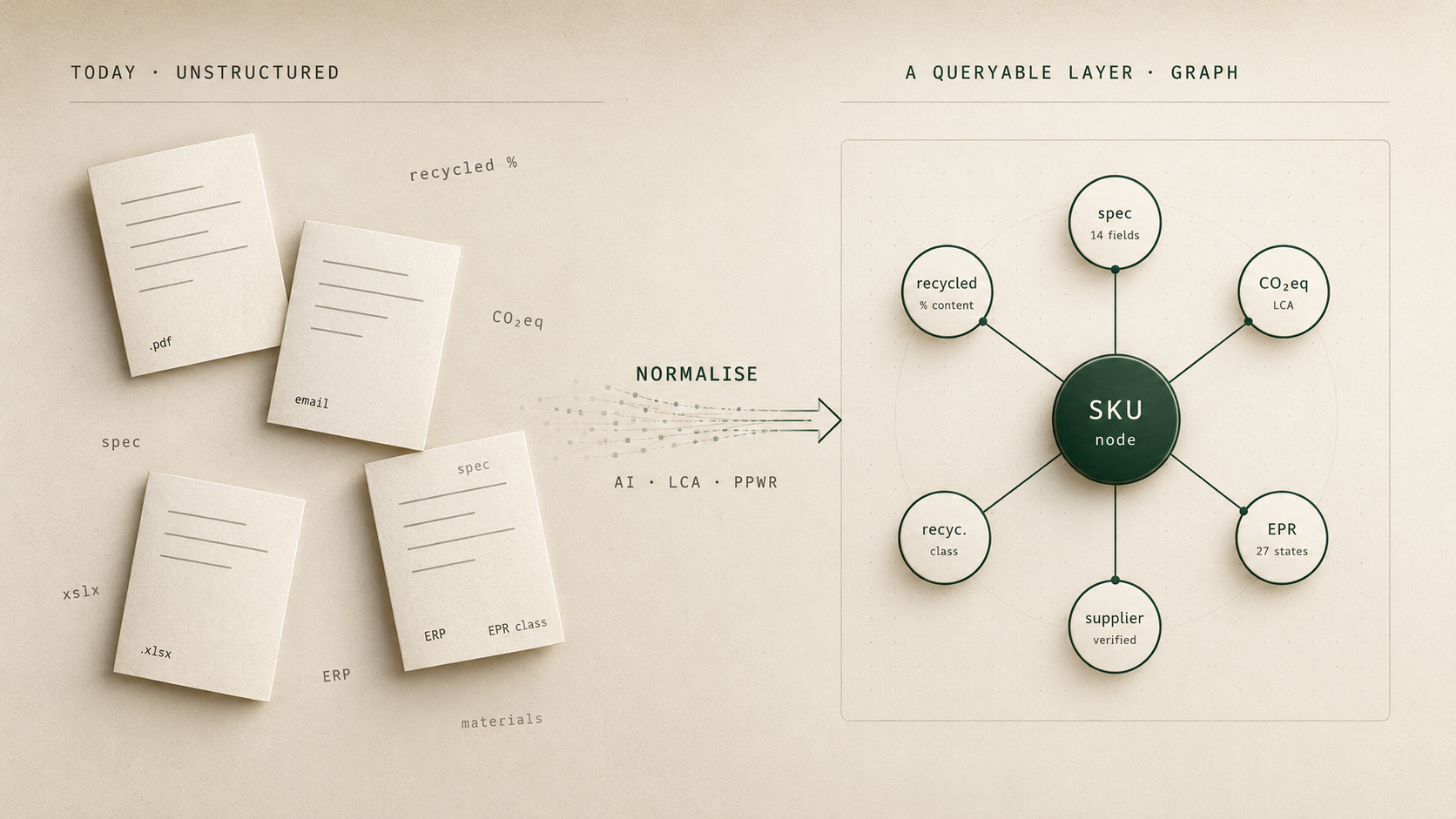
From fragmented spec data to a unified packaging graph
Fig. 01 – From fragmented documents to a queryable layer Source: Circulate · 2026

The shift now underway is from treating packaging as a procurement problem to a data problem. Once the data layer exists, every tool becomes an application on top of it. Speeding up the circular transition of packaging is one of the highest-leverage moves against overconsumption, and the data layer is the bottleneck. The business case and the climate case are the same case.

Each new SKU ingested makes every downstream application better for every existing user. That is the property a packaging marketplace has never had and a packaging compliance tool can never have.
€1.2tn

Global packaging industry

~€250bn

European packaging market

€7bn

Packaging-software TAM, estimated by 2030: PIM, procurement and compliance

€1.5–2bn

Serviceable available market

€100m ARR

Under 2% of SAM

Two independent methods — bottom-up tiered pricing across ~4.4M obligated EU companies, and top-down category capture — converge on ~€7bn. Sources: Smithers, Eurostat SBS, ZSVR/LUCID.

The industry addresses the problem in pieces, and none of them solve it. In practice, that means Excel, email and a generic ERP, sometimes with reporting consultants who hand back templates the buyer still fills in by hand. A few packaging-specific tools exist but are rare. Every compliance report or buyer data request becomes hours of manual labour. The software that does exist fails the same way: compliance tools presume the data exists; marketplaces are listings, not data; supplier portals only see their own catalogue.

01 – Canonical

One representation, every application.

A single, normalised model of what a packaging SKU is. Not one schema per buyer or per supplier, but a shared model every downstream tool can rely on.

02 – Two-sided

Crosses the buyer–supplier boundary.

A data layer filled in by only one side reproduces the silos it is meant to dissolve. The data has to be entered once, by whoever is closest to it, and be available to both sides.

03 – Live

Refreshed by the workflows running on it.

Every new SKU ingested, every supplier verification, every restock order writes back to the graph. The applications maintain the data layer they depend on. Static catalogue data goes stale in months.

04 – Auditable

Regulatory-grade by default.

PPWR, EPR, CSRD and the Digital Product Passport all require auditable provenance. Compliance is a property the layer either has from day one or never gets right retroactively.

The data graph, and the applications on top.

00

Database (foundation)

The graph: up to 200 datapoints per item (materials, weights, recyclability, LCA, PFAS, labelling), AI-extracted from specs, sheets and certificates. Every surface sits on it; every transaction enriches it.

01

Insights & Dashboards

Turns the graph into decisions: cost, quality, sustainability, service level, order patterns at SKU resolution. Surfaces what to fix; feeds Find & Replace and Restock & Forecast.

02

Find & Replace

Cheaper, lighter, more sustainable substitutes for items already in use. Searches Europe's largest packaging database; if nothing fits, an automated RFQ engine returns apples-to-apples options from relevant suppliers.

03

Restock & Forecast

The savings live in service level, shipping, storage and order patterns, not in chasing cents. ML-driven restock patterns optimised for cost, liquidity and co-shipping; financing built in when volume discounts beat capital cost.

04

Comply & Report

Compliance needs proof. Certificates and documents of conformity linked to each SKU in a structured table, not buried in folders. Reports flow upstream to PROs and EPR registers, and downstream as supplier-side data for customers' PPWR, CSRD and DPP reports.

05

Supplier Suite

The same infrastructure, supplier-deployed: AI ingests upstream specs in any format, suppliers verify, client locks. Auto-enriched with LCA and labels. On top sit restock portals, exports, dashboards, screening and sales channels. The graph serves as the supplier's PIM, feeding ERP and production.

I can understand why your competitors recommended you. We looked at eight similar solutions, shortlisted two, and now it’s only you. The solution is amazing, precisely what we need.

– Head of Sustainability · One of Sweden’s largest packaging resellers

Gross sales · LTM
10 MSEK+

Gross sales over the last 12 months.

SaaS ARR
1 MSEK

From zero in 18 months.

Suppliers in network
500+

European packaging suppliers in the network. 127+ formally onboarded across four years of operations.

Structured SKUs
5,000+

Normalised packaging items at SKU resolution, with 8,000 more onboarding.

Marketplace buyers
150+

Buyers served through the marketplace.

Order frequency
40

Orders per month.

SaaS customers signed
10+

Customers signed to the SaaS platform.

Case · Electronics recommerce · Foxway

Deployed the packaging portal across all warehouses; defined group-wide packaging standards and compliance criteria. Onboarded 200 SKUs and produced the first group-consolidated CSRD report Foxway had ever delivered. On the 20–30 SKUs taken through optimisation: 14% cost reduction and 60%+ CO₂ reduction. Thirty months in, contracted through June 2027: six licenses, over 1 MSEK for 12 months, paid upfront.

Case · Premium outdoor apparel · Astrid Wild

Resourced their entire packaging operation. One example: replaced mailer boxes from a wholesaler with paper bags sourced direct from the manufacturer, achieving 80% cost reduction plus operational and shipping savings, with CO₂ down ~70–80%.

Case · Packaging reseller · Nyah Gruppen

Nyah Gruppen runs its packaging PIM on Circulate: 10,000 SKUs from 400+ suppliers serving ~4,000 customers. The three-year contract is paid annually upfront. One seller connects 4,400 companies to the network.

Selected customers
Asket Myrqvist Foxway Astrid Wild Galvin Green DeoDoc
Gross sales · kSEK

Roughly 3× year on year, 2024 to 2025.

The scalable, AI-first foundation is built, and that investment is behind us. A lean team of top-tier engineers ships 10× a day. With acquisition paused during the rebuild, the 3× came entirely from existing accounts expanding usage: land-and-expand, proven. Gross sales include SaaS, services, supplier-side revenue and marketplace GMV.

Gross sales in kSEK, 2024 vs 2025 3,341 2024 9,512 2025 ≈ 3× YoY
Fig. 02 – Gross sales 2024 vs 2025, kSEK Source: Circulate · 2026
Co-Founder · CEO

Karolina Ling-Vannerus

Stockholm School of Economics. Goldman Sachs (London). McKinsey & Company. Cupole Consulting. COO at Fenix Media Group (parent of Aqua Dental), bringing structure and strategy to two founder-CEOs, her first deep startup experience. Business Sweden Global Packaging Expert (Madrid, 2019–2021), the role that produced the founder thesis. Antler EIR and Advisor. Prins Daniel's Fellowship.

Co-Founder · CTO

Lars Jacobsson

Ten years at Mathem, one of Sweden's largest online grocery and logistics companies. Progression from Lead Developer to Principal Architect to Head of Infrastructure. Earlier: TripAdvisor Rentals (Oxford). Joined Circulate October 2024.

Supporting

Hannes Gustafsson (Founding Engineer, KTH Engineering Physics, ex-Burt Intelligence). Alejandro Jara (Business Operator). Kajsa Cedervall (Senior Packaging Expert). Erik Åhlin and Isak Jonsson on engineering. Board chaired by Elisabeth Dreijer von Sydow, with Alexander Paterson-Pochet (J12 Ventures), Henrik Kjellberg, Johanna Svanström Jonung, and Maria Bexell.

Cap table

Institutional: J12 Ventures · Antler · Almi · Philian · Flexopack · DHS. Notable angels: Per Hallius (Nefab board), Susanna Campbell (former CEO Ratos, chair H2 Green Steel and Northvolt), Sanna Westman (Creandum), Madeleine Magnerius (EQT, Goldman Sachs), Mårten Vading (Kreos Capital), Pia Engholm (DHS), Alan Daitch, Borja Moreno de los Rios (FJ Labs).

Advisors

Hjalmar Winbladh has mentored Karolina bi-weekly since 2024 through the Prins Daniel's Fellowship. Mats Linder (circular economy). Joakim Engström (sustainable materials). Daniel Forsman (CTO advisor; ex-Mathem, Sinch, Microsoft).

Next 12 months

The PPWR moment, won correctly.

Obligations went live 12 August 2026 — the compliance buying rush is now on. Most brands will buy thin compliance tools with manual data entry and no supplier data of their own. Circulate brands arrive pre-loaded; their suppliers were onboarded years ago through the marketplace. Our bet is the data layer plus value-creating applications on top, automating packaging work so customers can focus on their core business, cutting cost and footprint.

PPWR · SaaS scale · Profitability
12 to 36 months

The application surface expands.

New tools layer onto the data foundation, automating sourcing, forecasting, restocking and reporting (the tedious work that eats hours today). Integrations go bidirectional: for buyers, exports flow into CSRD tools and into PROs and authorities across all 27 EU markets, reports submitted rather than re-entered country by country. For suppliers, the database becomes the PIM, feeding ERP and customer tooling.

Public API · EU expansion · Series A
Long term

The canonical European packaging data layer.

Every participant (supplier, material producer, brand, recycler) has a data account in the foundation. Add your data once; share it with anyone in a click. PPWR enforcement, the Digital Product Passport, EPR registers and circular-economy traceability all plug into the same graph. Tools that today compete with Circulate become customers of the data. This is the position Verisk holds in insurance — the industry's data layer, valued at over 10× revenue (NASDAQ: VRSK).

DPP · EPR · Infrastructure

Both clocks are running now. Neither was true two years ago.

Regulatory · 12 Aug 2026

EU PPWR obligations are live.

Regulation 2025/40 entered force 11 February 2025; bulk requirements have been in force since 12 August 2026, with progressively stricter recyclability, recycled-content and reuse thresholds layering in through 2030, 2038, and 2040. Packaging placed on the EU market without compliant data cannot be sold there. This is not an ambition, but a present market-access requirement enforced through national EPR registers in twenty-seven member states.

Technological · 2025

Document understanding becomes economic.

Gathering data and documentation for an entire supplier's catalogue went from impossible (or weeks of manual work) to minutes. Hundreds of datapoints per SKU, scattered across catalogues, specs, ingredient lists, test results and certificates, in no shared format. Manual entry won't scale; supplier templates don't come back. AI document understanding flipped the economics in 2025, just as the regulatory clock started. The certificates aren't just files: they're the proof behind every claim.

Eighteen months from now, the question of who owns the canonical packaging data layer in Europe will be substantially answered. The buyers and suppliers who have made their choices will not unmake them.

We are raising 3–4 MSEK to take Circulate to profitability within 18–24 months, positioning the company for a larger seed in 2027 raised from strength, not necessity.

Angels and family offices have been our strongest sales channel, and adding more to the cap table accelerates both growth and the round. The 3–4 MSEK funds three things: commercial leadership (CCO hire) and PPWR-driven GTM now that obligations are live; the Supplier Suite as the structural buyer-acquisition channel; and the engineering throughput to keep the graph compounding faster than the compliance-only category around it. The next round is raised against revenue and a denser graph, not against a roadmap.

Raising
3–4 MSEK
Purpose
Profitability within 18–24 months
Use of funds
Commercial leadership (CCO hire) · PPWR GTM · Supplier Suite · Engineering
Next round
Larger seed, 2027 (from a profitable base, with more PPWR stress in the market)
Existing investors
J12 Ventures · Antler · Almi · Philian, and top Nordic / European angels
Conversation

If the thesis is right, let's have a conversation.

Someone will own packaging's data. Let's make sure it's us.

Request the data room →
karolina@circulatepack.com  ·  Birger Jarlsgatan 57 C, Stockholm